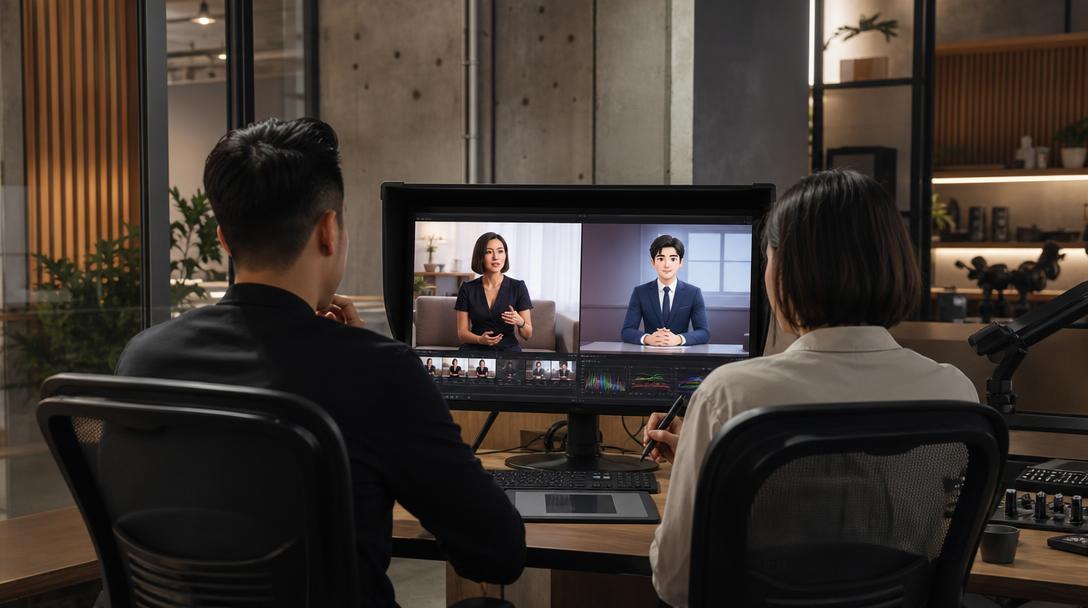
Before You Build a Digital Face for Your Brand, Read This
AI-generated avatars and digital spokespeople can appear on camera, deliver scripts in multiple languages, and scale across dozens of video formats without a single booking call. For Singapore brands managing high-volume content, that is a genuinely useful capability. But deploying one without understanding the consent, legal, and reputational dimensions involved is one of the faster ways to create a public relations problem. This article covers what brand decision-makers need to think through before a digital spokesperson goes anywhere near a live campaign.
What an AI Avatar or Digital Spokesperson Actually Is
The terminology is used loosely, so it helps to be precise.
Synthetic avatars built from scratch
These are fully generated digital characters with no real human origin. The face, voice, and movement are created by AI tools trained on broad datasets. Because no specific individual is being replicated, the consent considerations are different, though not absent.
Likeness-based avatars derived from a real person
These are built by training an AI model on footage, audio, or images of an actual individual, typically a brand ambassador, an employee, or a public figure. The resulting avatar can deliver new scripts the person never recorded. This category carries the most significant legal exposure.
AI-cloned voice with a separate visual presenter
Some productions separate the two: a real or generic visual presenter on screen, with an AI-cloned voice delivering the narration. This is common in multilingual localisation work, where the same visual asset is re-voiced into Mandarin, Malay, or Tamil. Even this narrower application requires proper consent from the original voice talent.
The Consent Question Is Not Optional
Singapore does not yet have a standalone deepfake or synthetic media law, but existing frameworks apply directly to avatar production.
Personal Data Protection Act (PDPA): A person's voice, facial geometry, and movement patterns are personal data. Training an AI model on an identifiable individual without their explicit, documented consent is a PDPA compliance issue. This applies to employees and contractors as much as it does to external talent.
Defamation and passing off: Deploying a synthetic likeness of a real person in a commercial context, even with their initial consent, can create liability if the content is later used in ways the person did not agree to. "I signed a release" is not a complete answer if the scope of use was not clearly defined in writing.
Platform terms of service: YouTube, Meta, and TikTok all have policies requiring disclosure of AI-generated or synthetically altered content, particularly where it depicts real people. Failure to disclose is a terms violation that can result in content removal or account restrictions, neither of which is a good outcome mid-campaign.
Talent and union agreements: If you are working with a talent who has any guild or collective agreement, check whether that agreement addresses AI replication. This is an actively evolving area, and some contracts now explicitly prohibit the creation of AI likenesses without separate negotiation.
The practical conclusion: if a real person's face or voice is involved, you need a written agreement that specifies exactly what the AI model will be used for, on which platforms, for how long, and under what conditions the person can revoke consent. Get legal counsel involved before production begins, not after.
Reputational Considerations That Do Not Fit in a Contract
Legal compliance and reputational safety are not the same thing. A few scenarios Singapore brands should think through:
The uncanny valley problem. Audiences are increasingly sensitive to synthetic media. A digital spokesperson that reads as slightly off, whether in facial movement, lip sync timing, or vocal cadence, can undermine the credibility of the entire message. In categories where trust is the primary selling point, such as financial services, healthcare, or legal services, this risk is amplified.
Transparency with your audience. Even where disclosure is not legally mandated, audiences who discover they have been watching a synthetic spokesperson without knowing it often react negatively. Proactive disclosure, done cleanly, tends to land better than post-publication correction.
Internal stakeholder buy-in. Before a brand publishes a video featuring a digital version of, say, its CEO or a senior spokesperson, that individual needs to have reviewed and approved not just the concept but the finished output. The reputational stakes for that person are real, and their discomfort after the fact is a problem you do not want.
Cultural reception in Singapore and the region. For regional campaigns running across Southeast Asia, what reads as innovative and credible in one market may read as cold or untrustworthy in another. This is particularly relevant when the avatar is used in contexts that carry interpersonal weight, such as a customer service interface or a brand apology video.
For a broader look at how AI production choices affect brand positioning, the article on AI video production budget for Singapore brands covers some of the strategic trade-offs worth considering alongside format decisions.
When AI Avatars Are the Right Production Choice
None of the above means avoid avatars entirely. There are genuine use cases where they perform well.
- High-volume explainer and training content where the priority is consistency and speed rather than emotional connection.
- Multilingual campaigns where re-shooting with a live presenter for each language is not financially viable.
- Always-on digital channels such as interactive kiosks, product demo pages, or chatbot interfaces where a consistent brand face adds value without replacing human relationship.
- Fully synthetic characters built specifically for the brand, with no real-person likeness involved, where the avatar becomes a brand asset in its own right.
The common thread in successful avatar deployments is that the production decision is made for a clear strategic reason, with proper consent documentation in place and transparent audience communication built into the rollout plan.
When This Approach Is Not Suitable
AI avatars are not the right tool for every brief. Consider an alternative if:
- The campaign requires emotional authenticity that synthetic presentation cannot yet reliably deliver.
- Your target audience includes demographics that research consistently shows are less receptive to synthetic media.
- The subject matter, such as a brand apology, a community commitment, or a sensitive public announcement, demands the weight that only a real human presence carries.
- You do not have the legal resources to put a robust consent and usage agreement in place before production begins.
- The production timeline does not allow for the iteration required to get avatar quality to a standard your brand would be comfortable publishing.
If you are still determining which format serves your brief, the comparison in AI video production versus traditional production may help frame the decision.
Working With a Production Partner
The questions of consent, disclosure, and platform compliance are not things a brand should navigate alone, particularly on a first avatar project. A capable AI video production company will have established workflows for consent documentation, will advise on disclosure language for each platform, and will quality-check the output against the realism standards the brand requires before anything goes to a client review. Ask your production partner directly: what does your consent process look like, and what happens if the avatar output does not meet quality threshold?
Frequently Asked Questions
Do I legally need to disclose that a spokesperson is AI-generated in Singapore? There is currently no Singapore law that mandates disclosure for all synthetic media in commercial contexts, but platform terms of service for Meta, YouTube, and TikTok do require it in specific circumstances. Beyond compliance, proactive disclosure is generally the lower-risk reputational choice.
Can I use a real employee as the basis for an AI avatar without a separate agreement? Not safely. Their employment contract almost certainly does not cover AI likeness replication. You need a specific, written consent document that defines the scope of use, the platforms involved, the duration, and the employee's right to withdraw consent.
What makes a fully synthetic avatar different from a likeness-based one for legal purposes? A fully synthetic avatar with no real-person origin does not trigger PDPA obligations around personal data, because no identifiable individual's data is being processed. However, if the synthetic character is designed to resemble a real person closely enough to be mistaken for them, defamation and passing-off risks can still apply.
If you are planning an avatar or digital spokesperson project and want to work through the production and compliance questions with an experienced team, discuss your production brief with Glory Forest Media.